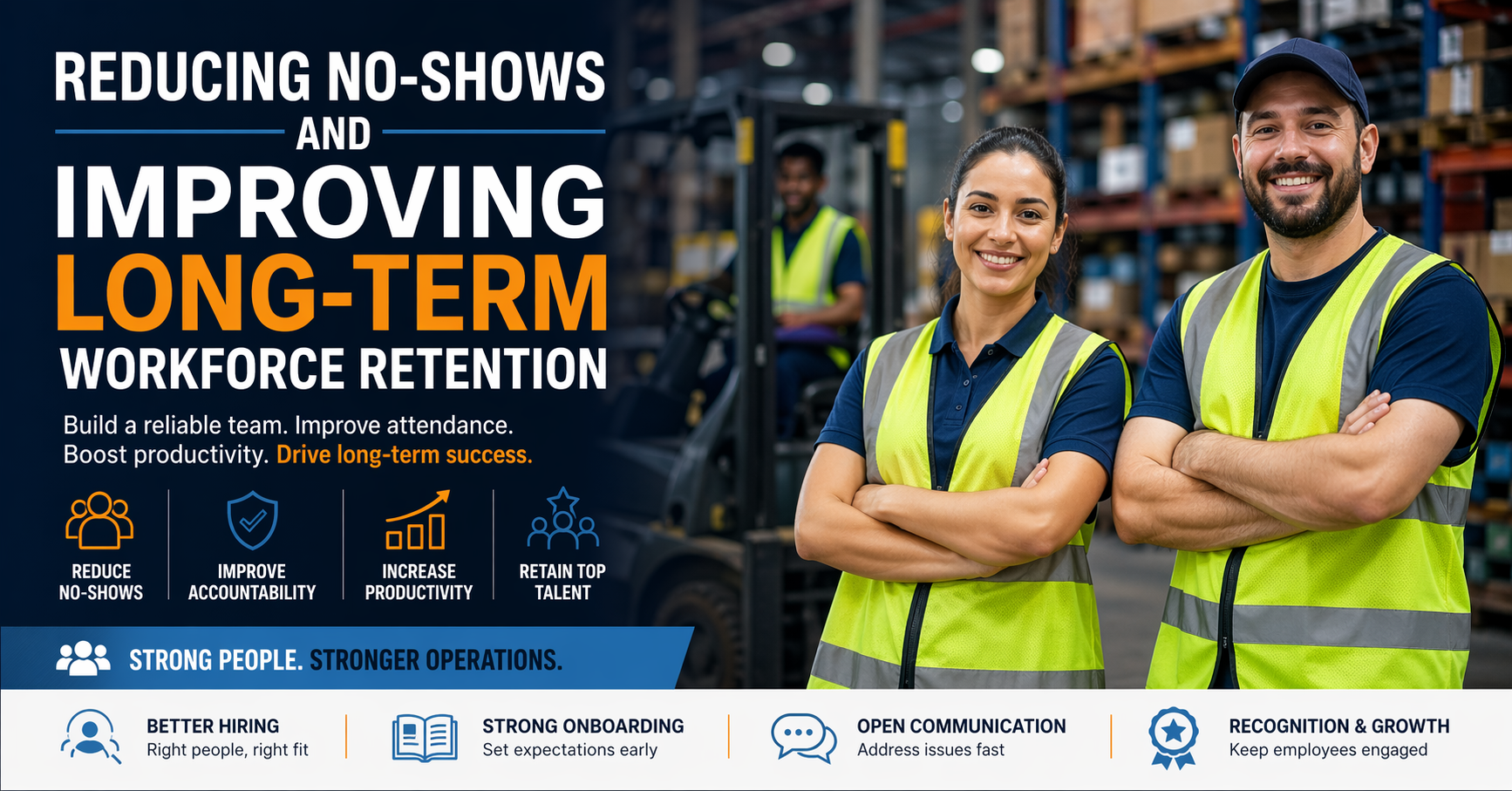
For manufacturing facilities, warehouses, food production plants, and distribution centers, employee no-shows remain one of the most expensive and frustrating workforce challenges. One missed shift may seem small, but in industrial operations, even a single absent worker can disrupt an entire production schedule.
A missing forklift operator can delay shipments. A machine operator absence can slow down an entire line. A production associate not showing up can force supervisors to reshuffle staff, increase overtime costs, and create unnecessary stress across the operation.
Many employers focus heavily on recruitment and filling open roles quickly, but the real solution is not always hiring more people—it is keeping the right people longer.
Long-term workforce retention is what separates highly efficient manufacturers from companies constantly stuck in emergency hiring mode.
If your business is constantly replacing workers, dealing with attendance issues, and struggling with turnover, the problem is rarely just recruitment. It is usually a retention strategy problem.
You may also want to review our guide on Why Employee Retention Is Better Than Constant Recruiting to better understand the financial impact of turnover across industrial operations.
The True Cost of Employee No-Shows
Most employers calculate labor costs based on hourly wages.
Very few calculate the real operational cost of a no-show.
When an employee fails to report to work without notice, the hidden costs quickly multiply:
- Production schedules fall behind
- Orders are delayed
- Shipping deadlines are missed
- Existing employees work overtime
- Supervisors lose time covering labor gaps
- Temporary staffing costs increase
- Customer satisfaction suffers
- Workplace morale drops
- Burnout increases among reliable staff
For manufacturing and warehouse employers, consistency is everything.
No-shows damage operational flow, but they also create a larger long-term issue: reliable employees begin leaving because they are tired of constantly covering for unreliable workers.
This becomes a retention problem, not just an attendance problem.
According to workforce studies published by organizations like SHRM, replacing employees can cost significantly more than retaining existing workers—especially for skilled labor roles.
That is why many employers are now investing more heavily in workforce retention rather than reactive hiring.
Why Workers No-Show
Before fixing the problem, employers must understand why it happens.
Most no-shows are predictable and preventable.
1. Poor Job Matching
One of the biggest causes of early turnover is poor candidate-job alignment.
Candidates often accept roles without fully understanding:
- shift schedules
- physical demands
- overtime expectations
- transportation requirements
- workplace pace
- production targets
- supervisor expectations
If workers feel surprised after Day One, many simply do not return.
This is extremely common in high-volume warehouse staffing.
Employers should also review Temp Staffing vs Direct Hire: What’s Better for Industrial Employers? when evaluating long-term workforce planning strategies.
2. Weak Onboarding
Rushed onboarding creates confusion and disconnection.
When employees are pushed into production without proper orientation, they feel unsupported and disposable.
This leads to fast exits.
Workers need clarity around:
- attendance expectations
- workplace safety
- break policies
- reporting structure
- payroll details
- performance expectations
- onboarding training requirements
The first week often determines whether someone stays for six months—or disappears after two shifts.
3. Poor Communication
Workers leave managers before they leave companies.
If communication between recruiters, HR, supervisors, and workers is weak, attendance problems rise quickly.
Small frustrations become resignation triggers when nobody follows up.
Examples include:
- payroll concerns
- unclear schedules
- transportation issues
- supervisor conflicts
- PPE confusion
- overtime misunderstandings
Proactive follow-up reduces preventable turnover.
This is especially important for temp workers transitioning into permanent roles.
4. Transportation Challenges
In industrial staffing, transportation is one of the most overlooked retention risks.
Warehouses are often located in industrial zones with limited transit access.
Night shifts make the issue worse.
Workers without reliable transportation become repeat attendance risks—even if they want to stay.
Pre-screening transportation reliability before placement dramatically improves retention.
5. No Long-Term Opportunity
Workers stay longer when they see a future.
If employees believe the job is temporary, unstable, or offers no growth path, commitment drops.
Retention improves when employers clearly communicate:
- temp-to-perm opportunities
- pay progression
- promotion paths
- cross-training options
- benefits eligibility
- long-term career stability
Retention starts with visibility.
People stay where they see opportunity.
Retention Starts Before Day One
One of the biggest mistakes employers make is assuming retention begins after hiring.
It starts during recruitment.
Clear expectations during the interview process reduce turnover significantly.
Employers should clearly explain:
- exact shift schedules
- attendance rules
- overtime expectations
- work environment
- physical job demands
- transportation expectations
- workplace culture
- safety requirements
- advancement opportunities
This is where experienced staffing agencies create real value.
Strong staffing partners focus on qualification—not just speed.
Fast hiring without screening creates turnover.
Strategic hiring creates retention.
For example, industrial recruiters who specialize in warehouse staffing often screen specifically for attendance history, transportation reliability, and shift commitment before submitting candidates.
That reduces no-shows dramatically.
You can also learn more from Canadian Manufacturers & Exporters about workforce planning challenges facing manufacturers across Canada.
How Better Onboarding Reduces Turnover
The first 7 days are critical.
Employees decide quickly whether they will stay or leave.
A strong onboarding process should include:
Clear Orientation
Workers should understand:
- job duties
- production expectations
- attendance rules
- safety procedures
- reporting structure
- emergency contacts
- payroll timelines
- workplace policies
Confusion creates turnover.
Clarity creates retention.
Supervisor Introductions
Human connection matters.
Employees who meet supervisors early and feel welcomed are far more likely to stay.
Feeling invisible increases early resignation risk.
Even simple introductions improve retention.
Day 1 / Day 3 / Week 1 Follow-Ups
Many turnover issues can be prevented through fast check-ins.
A quick follow-up catches:
- transportation problems
- shift misunderstandings
- payroll concerns
- supervisor conflicts
- training confusion
Before these become resignations.
Retention improves when workers feel someone actually cares.
Training Verification
Especially in manufacturing and food production, training must be verified—not assumed.
This includes:
- equipment procedures
- GMP compliance
- WHMIS training
- safety policies
- forklift protocols
- PPE expectations
Retention and compliance go together.
Employees who feel prepared stay longer.
Attendance Policies Must Be Consistent
One of the fastest ways to lose good workers is inconsistent accountability.
Reliable employees notice when poor attendance is tolerated.
If no-shows face no consequences, your best workers often become your next resignations.
Employers need:
- written attendance policies
- documented warnings
- clear reporting procedures
- supervisor accountability
- immediate absence follow-up
- replacement escalation plans
Consistency protects workplace culture.
Retention improves when fairness exists.
This is especially important in high-volume manufacturing operations running multiple shifts.
Why Temp-to-Perm Hiring Improves Retention
Temp-to-perm hiring creates stronger long-term stability.
It allows both the employer and the worker to evaluate fit before permanent commitment.
This model improves retention because it:
- reduces rushed permanent hires
- improves attendance accountability
- allows employers to identify top performers
- creates motivation for workers seeking full-time placement
- reduces first-month turnover
- improves supervisor confidence in hiring decisions
Workers are more committed when they see a clear path to permanent employment, benefits, and long-term growth.
Employers reduce bad hires.
Both sides win.
This is why many industrial employers now prioritize temp-to-perm workforce models over traditional direct hire alone.
How Staffing Agencies Improve Workforce Retention
A strong staffing agency should do much more than send resumes.
The right staffing partner becomes part of your retention strategy.
This includes:
- screening for attendance reliability
- transportation verification
- shift commitment validation
- backup worker pipelines
- onboarding support
- same-day replacement solutions
- supervisor feedback loops
- performance tracking
- worker retention reporting
For employers running large warehouse or manufacturing operations, this creates operational stability.
Staffing should not be treated as emergency hiring support.
It should function as workforce planning support.
This is especially valuable for employers working within MSP and VMS hiring structures.
Long-Term Retention Is the Real Competitive Advantage
Recruitment gets attention.
Retention drives profitability.
Companies that reduce turnover gain:
- stronger production output
- lower overtime costs
- better morale
- improved workplace safety
- reduced hiring spend
- stronger customer satisfaction
- better shift coverage
- predictable labor planning
- higher operational efficiency
In today’s labor market, keeping reliable workers is often harder—and far more valuable—than finding new ones.
The goal should never be simply filling positions.
The goal should be building a workforce that stays.
That is where real growth happens.
You may also find value in our article on How Staffing Agencies Help Employers Scale Faster Without HR Headaches for a broader workforce strategy approach.
Final Thoughts
Reducing no-shows is not simply an attendance issue.
It is a hiring strategy.
It is a leadership strategy.
It is a retention strategy.
The strongest manufacturers and warehouse operators focus on prevention—not constant replacement.
When employers improve communication, onboarding, accountability, and workforce planning, retention improves naturally.
The companies that win are not the ones hiring the fastest.
They are the ones keeping the right people longer.
Because in manufacturing and warehousing, stability is everything.
And stability starts with making sure your best workers show up tomorrow—and want to come back next week.