Introduction: Why This Matters More in 2026 Than Ever Before
Warehouse and manufacturing operations across the United States and Canada are operating under tighter margins, higher wage pressure, increased compliance scrutiny, and ongoing labor shortages.
In this environment, hiring mistakes are no longer minor setbacks. They are financial liabilities.
While most employers calculate hourly wages and recruiting expenses, very few fully account for the total operational impact of a bad hire. In industrial environments, that impact extends far beyond payroll. It touches productivity, safety, overtime budgets, morale, client performance metrics, and regulatory exposure.
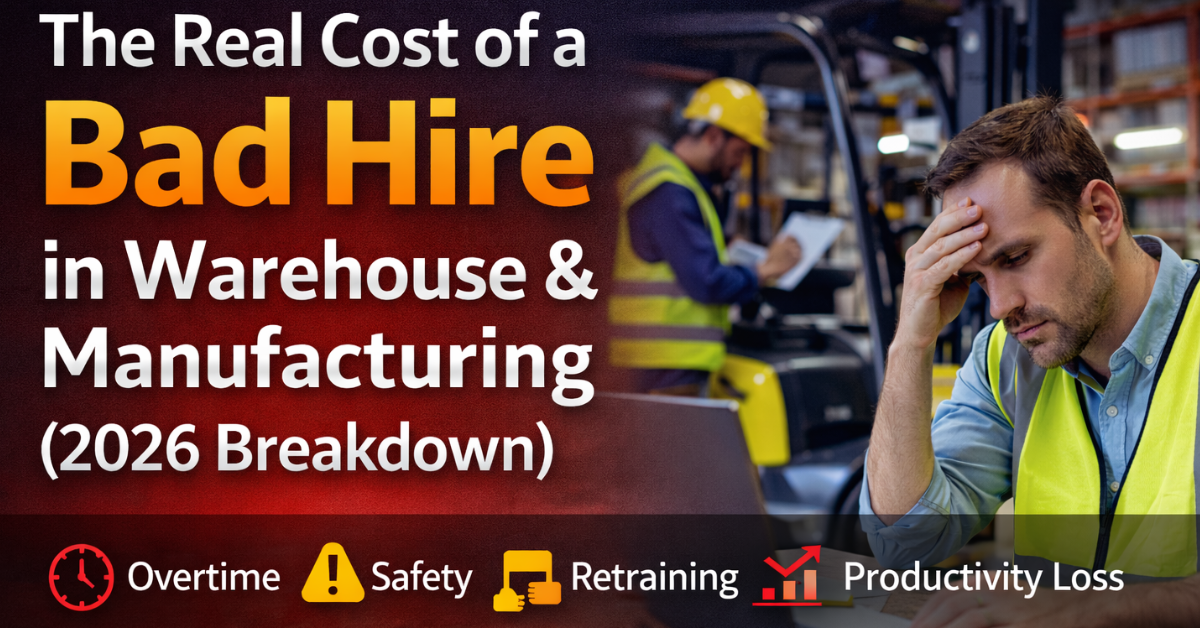
In 2026, the true cost of a bad hire in warehouse and manufacturing settings often ranges between $15,000 and $40,000 per employee — and in some cases, much more.
This article breaks down the real numbers and explains how employers in both Canada and the United States can mitigate hiring risk.
Defining a “Bad Hire” in Industrial Operations
In white-collar environments, a bad hire may mean underperformance or cultural misalignment. In warehouse and manufacturing environments, the consequences are amplified.
A bad hire in industrial operations typically falls into one or more of the following categories:
- Chronic absenteeism or unreliable attendance
- Failure to meet productivity standards
- Poor equipment handling (forklifts, pallet jacks, machinery)
- Inability to comply with safety procedures
- GMP non-compliance in food production
- Early resignation within the first 90 days
- Behavioral issues affecting team dynamics
Unlike office roles, industrial positions directly impact physical output. One unreliable employee can disrupt entire shifts, delay production schedules, increase overtime reliance, and raise safety risk across the floor.
The 2026 Cost Breakdown
Let’s examine a conservative example.
Assume a warehouse associate earning approximately:
- United States: $18–$24 per hour
- Canada: $17–$22 per hour
Using a $20/hour average, here is what one bad hire can realistically cost.
1. Recruitment and Onboarding Costs
Before an employee even begins productive work, employers incur:
- Job board advertising fees
- HR time spent screening resumes
- Interview coordination
- Background checks
- Drug testing
- Employment verification
- Administrative onboarding
- Safety and compliance training
Depending on the market, recruitment cost per hire can range from $2,500 to $4,000 — even before wages begin.
For higher-skilled roles such as forklift operators, machine operators, or welders, recruiting expenses can exceed $5,000 per hire due to certification requirements and limited labor pools.
2. Training and Productivity Ramp-Up Loss
Industrial employees do not reach full productivity immediately. During the first two to four weeks, most operate at 50–70 percent efficiency.
Supervisors and team leads invest additional time in:
- Equipment training
- Safety briefings
- Process demonstrations
- Quality control checks
If the employee leaves within 60 days, the organization has paid full wages while receiving partial productivity.
Conservatively, this lost productivity can cost $3,000 to $6,000 per employee.
In specialized manufacturing roles, the ramp-up period may extend to 8–12 weeks, increasing financial exposure.
3. Overtime Ripple Effects
When a hire underperforms or leaves unexpectedly, the burden shifts to existing staff.
This often results in:
- Increased overtime
- Fatigue-related errors
- Declining morale
- Higher injury risk
For example, if three employees each work five overtime hours per week at time-and-a-half, the cost accumulates quickly.
At $30 per hour overtime:
$30 × 5 hours × 3 employees = $450 per week
Over six weeks = $2,700
This does not include the hidden cost of fatigue-related safety risks or decreased long-term retention among strong performers.
4. Safety and Workers’ Compensation Risk
Industrial environments carry inherent physical risk.
An inexperienced or careless employee can cause:
- Equipment damage
- Product waste
- Workplace injuries
- OSHA or Ministry of Labour investigations
- Workers’ compensation claims
Average serious workplace injury costs:
- United States: $40,000+ per claim
- Canada: $30,000+ depending on province and severity
Even minor claims can increase insurance premiums for years.
A single forklift incident can eliminate the financial margin of an entire contract.
5. Turnover Replacement Cycle
Warehouse and manufacturing roles continue to experience elevated turnover in 2026, particularly within the first 90 days.
Replacing one employee requires repeating:
- Recruitment advertising
- Screening
- Background checks
- Onboarding
- Training
Replacement cycles typically cost between $4,000 and $8,000 per occurrence.
When turnover becomes systemic, costs compound rapidly.
Total Financial Impact
When combining conservative figures:
Recruitment: $3,000
Training loss: $4,500
Overtime impact: $2,700
Replacement cycle: $5,000
Total estimated cost: $15,000–$25,000
For skilled roles or safety-related incidents, the cost can exceed $40,000 per bad hire.
Why Industrial Hiring Errors Are More Expensive Than Office Mistakes
In warehouse and manufacturing settings, mistakes affect operational output directly.
Consequences may include:
- Missed shipping deadlines
- Production bottlenecks
- SLA penalties
- Product recalls
- Audit failures
- Client dissatisfaction
In food production, compliance lapses involving hygiene or contamination can trigger regulatory action and brand damage.
The margin for hiring error is significantly smaller in industrial environments than in administrative settings.
Manufacturing Hiring Mistakes Still Common in 2026
Despite technological advancements and labor analytics tools, common errors persist:
- Hiring based solely on urgency
- Failing to validate attendance history
- Skipping reference checks
- Overreliance on job boards
- Lack of structured skill testing
- Inadequate safety onboarding
Speed often overrides diligence, particularly during peak season hiring. However, reactive hiring frequently leads to higher long-term cost.
Temp Staffing vs Direct Hire: A Risk Management Comparison
One of the most strategic decisions employers face is choosing between direct hire and temporary staffing models.
Direct Hire Model
Employers assume:
- Full recruitment risk
- Immediate payroll liability
- Workers’ compensation exposure
- Termination management
- Replacement costs
All risk is absorbed upfront.
Temporary or Temp-to-Perm Model
Employers gain:
- Real-world performance validation
- Attendance pattern assessment
- Productivity measurement before permanent conversion
- Reduced administrative burden
- Controlled liability during evaluation period
In many cases, temp-to-perm models significantly reduce hiring risk by allowing employers to assess performance before long-term commitment.
For industrial operations in Texas, Michigan, Ontario, and other high-volume logistics hubs, this approach has proven financially strategic.
US vs Canada: Cross-Border Hiring Risk Differences
While operational challenges are similar, regulatory environments differ.
United States
- Higher litigation exposure
- OSHA enforcement
- FLSA overtime regulations
- I-9 and E-Verify compliance
- State-specific workers’ compensation frameworks
Canada
- Provincial employment standards legislation
- WSIB / WCB premium structures
- Work permit compliance requirements
- Overtime thresholds by province
In both markets, compliance failures amplify the financial cost of a bad hire.
The Hidden Costs Employers Rarely Track
Beyond measurable expenses, bad hires impact:
- Supervisor burnout
- Team morale
- Retention of high-performing employees
- Client trust
- Brand reputation
High performers often disengage when forced to compensate for unreliable coworkers.
In tight labor markets, losing strong employees due to internal frustration can cost more than replacing underperformers.
How Employers Can Reduce Hiring Risk in 2026
Forward-thinking warehouse and manufacturing organizations are implementing structured safeguards:
- Comprehensive screening processes
- Attendance history validation
- Skill testing before placement
- Safety and compliance certifications prior to deployment
- First-90-day retention tracking
- Data-driven hiring KPIs
- Strategic temp-to-perm conversion policies
The goal is not simply filling roles quickly. It is reducing operational volatility.
Conclusion: Hiring Is a Risk Management Function
In 2026, industrial hiring is no longer a basic HR function. It is a strategic risk management decision.
The cost of a bad hire in warehouse and manufacturing environments extends far beyond wages. It touches productivity, safety, insurance premiums, compliance exposure, morale, and client relationships.
Organizations that treat hiring as a risk-control mechanism — rather than a reactive necessity — are better positioned to protect margins and scale sustainably.
The smartest employers are no longer asking how quickly they can hire.
They are asking how effectively they can reduce hiring risk.